Since the Rwandan Patriotic Front (RPF) came to power in 1994, Rwanda has achieved significant progress in reconstruction, economic development and public security following the 1994 Genocide against the Tutsi. Yet behind this image of stability lies a political environment in which dissent remains highly restricted.
For decades, human rights organisations have documented restrictions on political opposition, freedom of expression, freedom of association and independent journalism. Opposition politicians, journalists, human rights defenders, artists, activists and former government officials who have challenged or criticised the authorities have faced arrest, prosecution, imprisonment, intimidation, disappearance and, in some cases, death.
Human Rights Watch reported that in 2025 the Rwandan government continued to repress political opposition and that few journalists, civil society activists or opposition members were willing to speak publicly against the government or its policies. Amnesty International has similarly described Rwanda’s civic space as severely restricted, with opposition members facing prosecution and independent media and civil society actors facing intimidation and reprisals.
Victoire Ingabire: Opposition Behind Bars
Victoire Ingabire Umuhoza has become one of the most prominent symbols of Rwanda’s restricted political space.
After years in exile, Ingabire returned to Rwanda in 2010 with the intention of participating in the presidential election. She was arrested and later convicted on charges including conspiracy against the government and genocide-related offences. She remained in prison for several years before receiving a presidential pardon in 2018.
Rather than abandoning politics, Ingabire continued to advocate for political pluralism. In 2019, she founded DALFA Umurinzi, a political movement seeking democratic and political change.
The authorities have not allowed the party to operate as a registered political party capable of participating in elections.
On 19 June 2025, Ingabire was arrested again. Her detention was linked to a case involving members and supporters of her political movement. Human Rights Watch described the arrest as part of continuing repression of political opposition.
Amnesty International subsequently called for the immediate release of Ingabire, members of DALFA-Umurinzi and a journalist detained in the same context, describing the case as part of a broader crackdown on opposition, journalists and civil society.
Ingabire’s story illustrates a central reality of Rwanda’s political environment: political dissent can continue to carry consequences even after years have passed and even when opposition activity is peaceful.
When Opposition Members Disappear
The repression of political opposition has not been limited to arrests and trials. Several opposition members have disappeared or died in circumstances that remain unresolved.
Boniface Twagirimana
Boniface Twagirimana, deputy leader of FDU-Inkingi, disappeared in October 2018 while detained at Mpanga Maximum Security Prison.
Authorities stated that he had escaped from custody. His family, lawyers and political colleagues disputed this explanation and continued to seek information about his fate.
His whereabouts remain unknown.
Illuminée Iragena
Illuminée Iragena, a nurse and member of FDU-Inkingi, disappeared in March 2016 while travelling to work.
Despite efforts by her family and supporters, her whereabouts have never been satisfactorily established.
Her disappearance has become one of the cases repeatedly cited in discussions about the risks faced by members of Rwanda’s political opposition.
Anselme Mutuyimana
Anselme Mutuyimana, an associate of opposition leader Victoire Ingabire, was found dead in March 2019.
The circumstances of his death generated serious concern among opposition supporters and human rights organisations. His death remains among the unresolved cases surrounding opposition activists.
Sylidio Dusabumuremyi
Sylidio Dusabumuremyi, a national coordinator of FDU-Inkingi, was killed in September 2019.
He was attacked by unidentified individuals. Although the authorities investigated the killing, concerns have remained regarding the circumstances surrounding the attack and the broader safety of opposition activists.
Eugène Ndereyimana
Eugène Ndereyimana, an opposition activist, disappeared in July 2019.
His disappearance remains unresolved and contributed to growing concerns among opposition groups regarding the safety of their members and supporters.
These cases do not by themselves establish who was responsible for every disappearance or death. But taken together, they form part of a troubling record of unresolved cases involving people associated with political opposition. Human Rights Watch has repeatedly called for credible and independent investigations into such cases.
Journalists Under Pressure
Political repression in Rwanda extends beyond political parties.
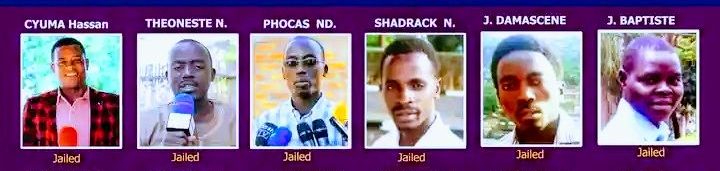
Journalists and independent media workers operating on sensitive political and human rights issues have also faced pressure, arrest, prosecution and intimidation.
John Williams Ntwali
Investigative journalist John Williams Ntwali, editor of The Chronicles, was known for reporting on sensitive political issues.
He died in January 2023. Authorities described his death as a motorcycle accident. Human Rights Watch called for an independent investigation, noting unresolved questions surrounding the circumstances of his death.
His death sent another chilling message through Rwanda’s media community.
Kizito Mihigo
Kizito Mihigo, a celebrated musician, composer and peace activist, became knoin for promoting reconciliation and speaking about victims of violence.
He was arrested in 2014 and convicted on national-security-related charges. After receiving a presidential pardon in 2018, he was arrested again in 2020 while allegedly attempting to leave Rwanda.
He subsequently died in police custody. Authorities attributed his death to suicide.
Human rights organisations and others questioned the official explanation and called for an independent investigation.
The death of Kizito Mihigo remains one of the most powerful examples cited by critics of the risks faced by prominent independent voices in Rwanda.
Innocent Bahati
Poet Innocent Bahati disappeared in February 2021.
His whereabouts remain unknown.
His disappearance further heightened concerns about the safety of artists and independent voices addressing social and political issues.
Critics in Exile Are Not Necessarily Safe
Rwandan political repression has also raised concerns beyond the country’s borders.
Some prominent critics have lived in exile after falling out with the government. Several have reported threats, surveillance or attacks.
From Rwanda to Exile: The Risks Facing RNC Members
Patrick Karegeya, a former head of Rwanda’s external intelligence service and confounder of the Rwanda National Congress (RNC), became one of the country’s most prominent political critics after leaving Rwanda.
He was found dead in a hotel in Johannesburg, South Africa, on 1 January 2014.
South African authorities investigated the killing. The Rwandan government denied involvement.
Nevertheless, Karegeya’s death has remained a powerful symbol in discussions about the risks faced by Rwandan dissidents abroad.
General Kayumba Nyamwasa, a former senior Rwandan military officer and founding member of the RNC, has lived in exile in South Africa.
He survived assassination attempts while in exile. The attacks generated international concern, although the Rwandan government denied involvement.
Together, these cases have contributed to concerns about the possibility of Transnational repression, in which political critics may remain vulnerable even after leaving their country.
Human Rights Watch has documented what it describes as a broader pattern of extraterritorial repression by the Rwandan authorities against critics and opponents abroad.
Ben Rutabana, a member of the Rwanda National Congress (RNC) and outspoken critic of the Rwandan government, disapeared in Uganda in September 2019. Hps disappearance raised serious concerns among his family, colleagues and Rwandan opposition networks, who have maintained that he may have been forcibly taken and have called for an independent investigation. His whereabouts remain unknown.
Eric Nshimiyimana, described by RNC members as an intermediary between opposition supporters inside Rwanda and members of the movement in neighbouring countries and in exile, also reported serious security concerns linked to his political activities. He faced threats and, according to accounts from opposition sources, survived several alleged attempts on his life before eventually leaving Rwanda.
His experience illustrates the risks reported by individuals perceived to be connected to Rwandan opposition networks. Beyond formal political leaders, supporters and intermediaries have also described surveillance, intimidation, arrest, threats and pressure because of their alleged political affiliations or contacts with opposition groups operating inside Rwanda and abroad.
Paul Rusesabagina: A Critic Taken Back to Rwanda
Paul Rusesabagina, internationally known for the story associated with Hotel Rwanda, became a prominent critic of President Paul Kagame and supported an opposition movement abroad.
In 2020, he was brought to Rwanda in circumstances that generated substantial international concern.
The United Nations Working Group on Arbitrary Detention later found his detention to be arbitrary.
Rusesabagina was convicted on terrorism-related charges and released in 2023 following a presidential commutation.
His case became internationally significant because it demonstrated the potential consequences faced by a prominent Rwandan government critic who was outside the country.
The Rwigara Family
The case of Diane Rwigara and her mother Adeline Rwigara provides another illustration of the difficulties surrounding political competition in Rwanda.
Diane Rwigara announced her intention to challenge President Kagame in the 2017 presidential election. Her candidacy was rejected by electoral authorities.
She and her mother were subsequently arrested and prosecuted on criminal charges.
Human rights organisations criticised the proceedings and raised concerns regarding freedom of expression and political participation.
Both women were acquitted in 2018.
The case nevertheless became a prominent example of the narrow space available to political challengers seeking to compete outside the ruling establishment.
A Culture of Fear
The individual cases tell a larger story.
When opposition politicians are arrested journalists are prosecuted, activists disappear, prominent critics die in disputed circumstances and dissidents report threats even after leaving the country, the consequences extend beyond the individuals directly affected.
They create a climate of fear.
- Journalists may censor themselves.
- Activists may stop organising.
- Opposition supporters may remain silent.
- Families may fear speaking publicly about missing relatives.
- Civil society organisations may hesitate to criticise government policies.
Human Rights Watch has reported that few journalists, civil society activists and opposition members in Rwanda are willing to publicly criticise the government or its policies. Amnesty International has similarly described Rwanda’s civic space as severely restricted.
This is perhaps one of the most significant consequences of repression: silence becomes a form of survival.
The Cost of Speaking Out
The stories of Victoire Ingabire, Boniface Twagirimana, Illuminée Iragena, Anselme Mutuyimana, Sylidio Dusabumuremyi, Eugène Ndereyimana, John Williams Ntwali, Kizito Mihigo, Innocent Bahati, Patrick Karegeya and other Rwandan critics are different in their circumstances.
- Some imprisoned.
- Some disappeared.
- Some died.
- Some fled the country.
- Others continue to live under political pressure.
What connects these cases is not necessarily a single established chain of responsibility for every incident. Rather, they illustrate the risks that can accompany political dissent, independent journalism and criticism of the government in Rwanda.
The continuing detention and prosecution of opposition figures in recent years demonstrates that these concerns are not merely historical. The repression documented by international organisations remains relevant today.
For Rwandans who have fled the country because of their political opinions, journalism, activism or criticism of the authorities, the question of what happens after exile therefore remains deeply important. Leaving Rwanda does not necessarily mean that the political consequences of dissent disappear. For critics, exile is not simply a change of residence. It is the continuation of a struggle for safety, freedom of expression and the right to disagree.
© 𝐍𝐞𝐰𝐬 𝐏𝐚𝐩𝐞𝐫𝐬/ 𝐑𝐚𝐝𝐢𝐨/ 𝐓𝐕