

𝐀cording to INTERPOL’s African Cyberthreat Assessment Report 2026.
The report found that 55% of cybercrime cases recorded across the continent involve the use of AI, raising concerns as Afri𝐜a’s digital economy continues to expand.
With more than 1.1 billion mobile subscribers in 2025, millions of people are relyi𝐧g on digital services, creating new opportunities for both innovation and cybercriminals.
Based on data from 36 African countries, the 40-page assessment says cybercrime has evolved into a highly organised, cross-border industry that is becoming harder for authorities to detect and stop.
Online scams remain Africa’s biggest cy𝐛er threat
According to the report, online scams remained the most common form of cybercrime in 2025. Criminals increasingly used artificial intelligence alongside social media platforms and mobile money services to target victims.
INTERPOL said cybercrime-related financial losses have risen sharply over the past year, climbing from $192 million in 2024 to $484 million. Investigators attribute the increase to AI-powered fraud, stolen login credentials and sophisticated social engineering attacks.
The report also found that 72% of surveyed countries identified scam centres operating within their borders, with the hig𝐡est concentration in West and Southern Africa.
Different regions face different cyber ri𝐬ks
The report highlights distinct cybercrime trends across the continent.
In East Africa, mobile money fraud and ransomware attacks targeting critical infrastructure are among the biggest threats.
West and Central Africa continue to ex𝐩erience high levels of business email compromise and romance scams affecting both companies and individuals.
Meanwhile, Southern Africa’s advanced digital connectivity has made the region an attractive target for international cybercriminal networks seeking to maximise disruption.
AI is making cybercrime more convincing
INTERPOL warned that artificial intelligence is transforming the way cybercriminals operate.
Deepfake technology and AI-generated content are increasingly being used in digital sextortion and online harassment campaigns. One of INTERPOL’s technology partners, TrendAI, detected around 600,000 sextortion cases linked to these tactics.
The report also noted a sharp rise in Business Email Compromise (BEC) scams, w𝐡ere criminals use AI to produce realistic emails that imitate trusted contacts.
Some Africa-based cybercriminal groups have targeted businesses and individuals in Europe and North America, using infrastructure spread across several countries to hide their activities.
Another growing concern is the use of synthetic identities. Rather than simply stealing personal information, cybercrimina𝐥s are combining genuine data with fabricated details to create entirely new digital identities.
These fake profiles have reportedly been used to open bank accounts, obtain mobile loans and register SIM cards while evading some biometric verification systems.
Gaps in cooperation leave financial syste𝐦s exposed
INTERPOL said weak coordination between banks, telecom companies and law enforcement agencies continues to hamp𝐞r efforts to combat cybercrime.
The absence of real-time information sharing creates opportunities for criminals to move stolen funds quickly and exploit weaknesses across multiple jurisdictions before authorities can respond.
The report also found that many African law enforcement agencies are still not adequately prepared to respond to AI-driven cyber threats, despite the rapid p𝐚ce at which the technology is being adopted by criminal networks.
Countries step up efforts against cybercrie
Despite the growing threat, the report 𝐩oints to progress across the continent.
In 2025, 17 African countries introduced or updated cybercrime legislation. Sene𝐟al also launched an online reporting platform designed to improve responses to online offences involving children.
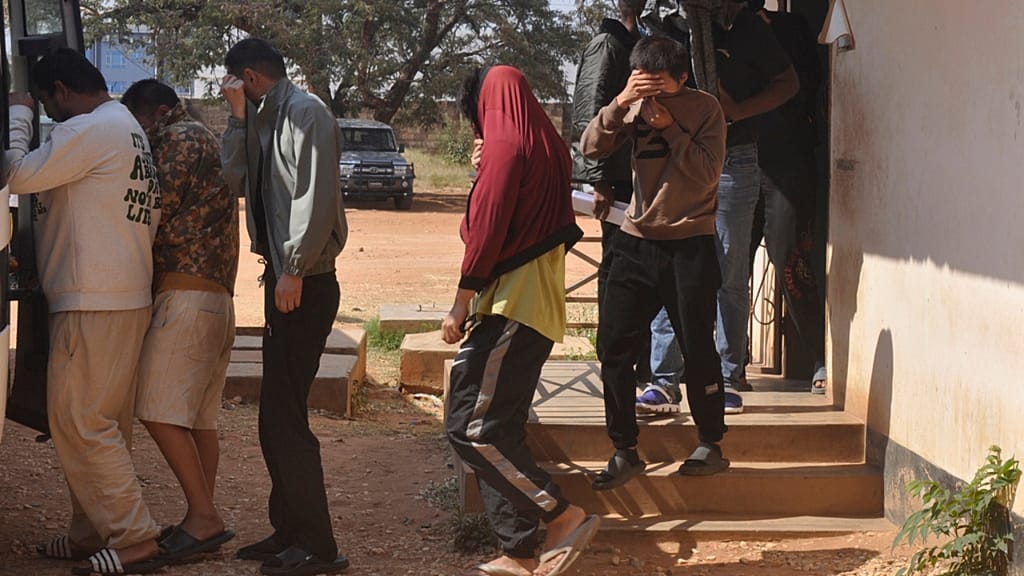
INTERPOL said joint international operations have also delivered significant resu𝐥ts. Four major operations, Operation Serengeti 2.0, Operation Contender 3.0, Operation Sentinel and Operation Red Card 2.0, led to more than 1,500 arrests, the seizure of hundreds of electronic devices and the recovery of over $100 million linked to cybercrime.
©𝐄𝐚𝐬𝐭𝐚𝐟𝐫𝐢𝐜𝐚𝐧𝐫𝐞𝐩𝐨𝐫𝐭.𝐜𝐨𝐦/𝐑𝐚𝐝𝐢𝐨/𝐓𝐕