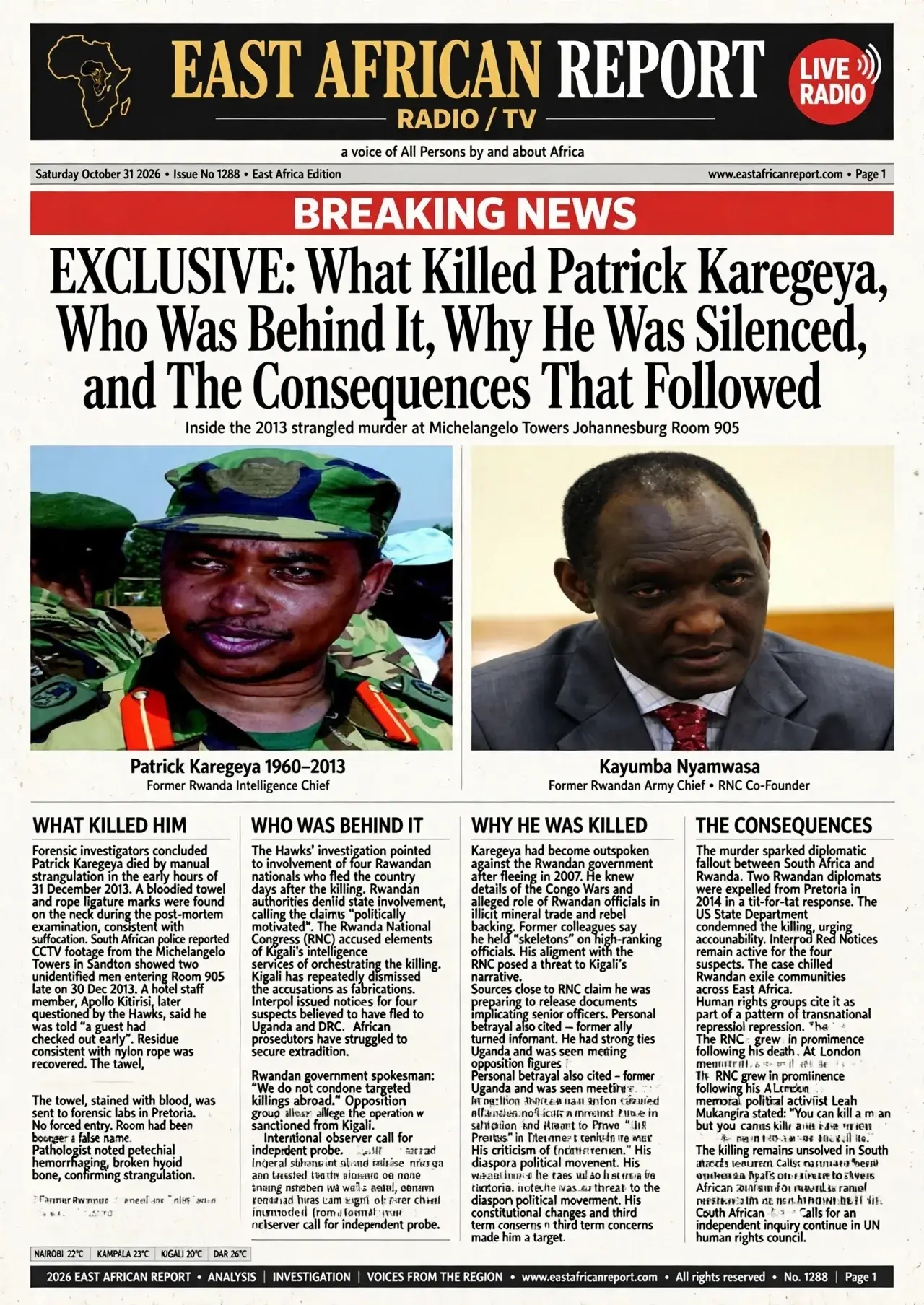

On New Year’s Eve 2013, former Rwandan intelligence chief Patrick Karegeya checked into the luxurious Michelangelo Towers Hotel in Sandton, Johannesburg. He never checked out alive.
On January 1, 2014, his body was found in Room 905, marking the beginning of one of Africa’s most controversial political assassinations.
WHAT KILLED HIM
According to the South African Police Service and forensic reports presented at the Johannesburg Magistrate’s Court, Patrick Karegeya did not die a natural death.
Police found his body on the bed with visible injuries. A forensic pathologist concluded the cause of death was manual strangulation. Investigators recovered a bloodied towel and a rope hidden in the room’s safe. His neck showed ligature marks consistent with asphyxiation.
Hotel CCTV footage showed that Karegeya had gone to the hotel for a meeting with Appollo Kiririsi Gafarara, a Rwandan businessman known to him. Kiririsi was seen entering the room on December 31 and leaving the next morning.
South African authorities classified the case as murder and opened a murder investigation.
WHO WAS BEHIND IT
No court has convicted anyone for the murder, but official investigations and statements point to a politically motivated killing.
1. The South African Investigation: In 2019, a formal inquest by the South African Hawks (Directorate for Priority Crime Investigation) heard evidence that linked the murder to Rwandan state operatives. The presiding magistrate said evidence suggested “direct involvement of the Rwandan government.”
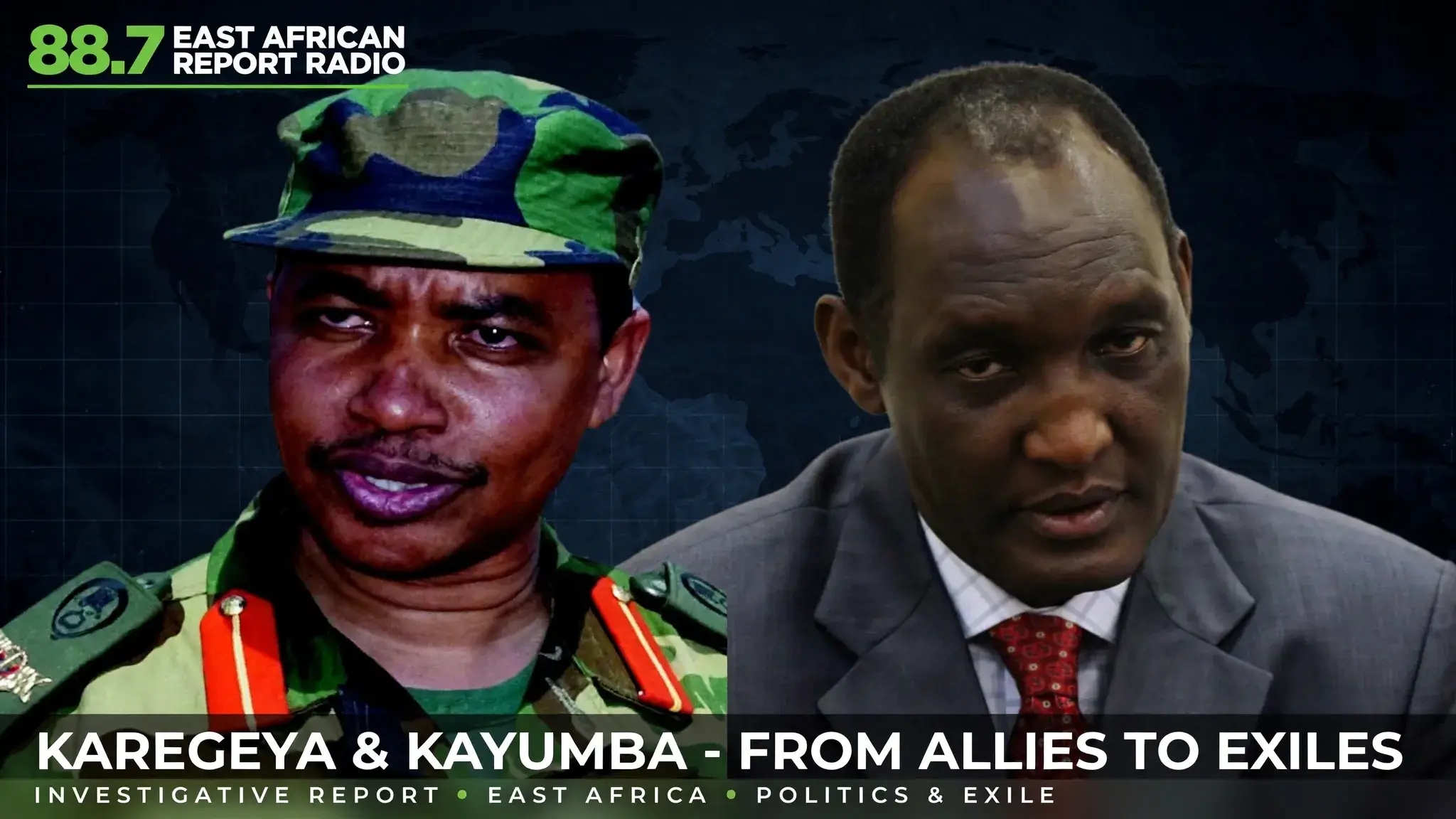
2. The Opposition Accusation: The Rwanda National Congress (RNC), the opposition movement Karegeya co-founded in exile in 2010 with former army chief Kayumba Nyamwasa, issued a statement to AFP in January 2014 saying: “He was strangled by agents of (Rwandan President Paul) Kagame, having previously survived several assassination attempts.”
3. The Government Denial: The Government of Rwanda has consistently denied any involvement. In official statements, Kigali said Karegeya was a “self-declared enemy of the state who turned against his country” and that Rwanda “had nothing to do with his death.”
Four Rwandan nationals were initially linked as suspects. Appollo Kiririsi was arrested and later acquitted due to lack of evidence and fled the country.
WHY HE WAS KILLED – THE MOTIVE
Intelligence analysts and those close to Karegeya cite three main reasons he became a target.
A. He Knew Too Much: As Director General of External Intelligence in the Rwandan Defence Forces from 1994 to 2004, Karegeya was at the center of Rwanda’s most sensitive operations. He coordinated intelligence during the Congo Wars and internal security. A source close to the government told AfroAmerica Network: “Patrick certainly knew where all the skeletons were buried.”
B. The RNC Threat: After fleeing to South Africa in 2007, Karegeya co-founded the RNC, which declared its aim to remove President Kagame from power. According to sources, he was building an elaborate intelligence network inside Rwanda and the region to overthrow the regime he helped create. Kigali viewed the RNC as a direct national security threat.
C. The Personal Betrayal: Karegeya and Paul Kagame were once close friends, from their days as exiled students in Uganda and deputies in Ugandan Military Intelligence. The friendship turned into bitter rivalry. President Kagame later claimed Karegeya was “in the pay of South African military intelligence.”
THE CONSEQUENCES FOR HIS KILLERS
The murder did not end without consequences.
Diplomatic Fallout: In March 2014, South Africa expelled three Rwandan diplomats linked to the case. Rwanda retaliated by expelling six South African diplomats. Relations between Pretoria and Kigali have never fully recovered.
International Condemnation: The murder was cited in the US State Department’s Human Rights Reports and by Human Rights Watch as a prime example of transnational repression – where governments target dissidents abroad.
The Case Remains Open: The murder case in South Africa has never been closed. It remains an open murder investigation. Interpol Red Notices were issued for some suspects.
A Martyr Effect: Instead of silencing the opposition, Karegeya’s death turned him into a martyr. His widow Leah Karegeya said at his funeral: “You can kill a man, but you cannot kill an idea.” The RNC gained international sympathy and support.
Patrick Karegeya left behind his wife Leah and three children. He is buried in South Africa after his family in Uganda declined to bury him, stating they considered themselves Ugandan.
Eleven years later, the question of who ordered the killing in Room 905 still haunts Southern Africa.