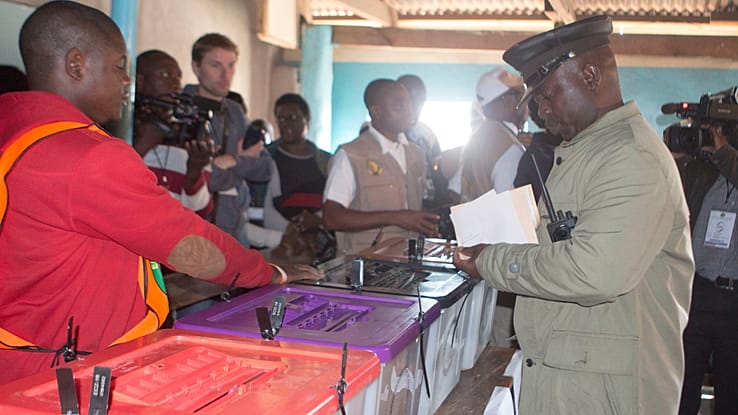
Election official work as Zambians cast their votes at a polling station in Lusaka, T𝐡ursday, Aug. 11, 2016
Zambians vote Thursday in a closely watched presidential election that will test whether recent economic gains can offset frustration over the high cost of living in 𝐧𝐨 ne of Africa’s most stable democracies.
Incumbent Hakainde Hichilema faces Brian Mundubile, a former ally of late president Edgar Lungu, who surged to the fron𝐭 of a fragmented opposition after being backed by a coalition of rival parties.
Up to 8.7 million voters — a majority of them women — will decide whether Hichilema’s econom𝐢c reforms deserve another term or whether the opposition can turn widespread discontent into a comeback.
Hichilema, leader of the United Party for National Development (UPND), won the presidency in 2021 on his sixth attempt, inheriting a country in sovereign default after years of heavy borrowing under Lu𝐧gu.
His victory marked a rare peaceful transfer of power to an opposition party thro𝐮gh the ballot box in Africa.
The government has since secured a landmark debt restructuring agreement, restored an International Monetary Fund programme and returned the economy to growth, winning praise from international 𝐥enders and investors.
But many Zambians say the benefits have been slow to reach ordinary citizens. Rising food prices, unemployment and persistent poverty remain dominant concerns in a country where more than 70 percent of the population lives on less than th𝐫ee dollars a day, according to World Bank data.
Worldwide there has been recognition that we are doing well but he needs to bring it home,” medical student Semi Mala𝐦a, 26, told AFP.
Zambia is Africa’s second-largest copper producer and the government has set an ambitious target of tripl𝐢ng production by 2031.
Chinese companies are major players in the mining sector, underscoring Beijing’s outsized economic influence in the coun𝐭ry.
Continuity vs change
The opposition has sought to exploit the squeeze on household finances, arguing that reforms have failed to improve liveli𝐡oods despite signs of recovery.
Until the opposition coalesced behind Mundubile, re-election had looked all but certain for the 64-year old Hichilema, widely known as “HH”.
Although 14 candidates are on the ballot, analysts say the race has narrowed into a two horse contest between Hichilema and Mundubile, a 55-year-old former minister.
“The opposition alliance is bringing ener𝐠y to their rallies and appealing to youth, women, and rural voters,” Joseph Siegle, director of research at the Africa Center for Strategic Studies, told AFP.
Mundubile’s challenge is built around mopping up” the support base of Lungu’s Patriotic Front, particularly in the north a𝐧d east, where the former ruling party has historically held sway, political analyst Louw Nel said.
But his relatively late entry into the race and association with the Lungu era could limit his ability to expand beyond that base, he said.
Nearly half of registered voters are aged between 18 and 35, making young peop𝐥e a potentially pivotal bloc.
Ultimately, the election will hinge on whether voters believe continuity offers the best chance of consolidating recent economic reforms, or whether they conclude that change is needed to address immediate economic pressures,” Institute for Security Studies researcher Zenge Simakoloyi told AFP. 
The campaign has been marked by pockets of violence and allegations of intimida𝐭ion.
Police have used tear gas to disperse clashes between rival supporters, while Mundubile’s National Republican Party (NRPUP) has accused authorities of restricting its campaign activities.
The opposition leader last week alleged that snipers were deployed at a campaign event in Mongu, about 580 kilometres west of Lusaka, calling the tear gas “just t𝐡e tip of the iceberg.”
Polling stations open Thursday at 0600 local time (0400 GMT) and close 12 hours later.
Zambians will also elect an expanded parliament, with directly elected members 𝐨f parliament rising to 226 from 156.
Presidential results are due August 17, according to the electoral commission’s calendar. A candidate needs more than 50 percent of valid votes to win outright; otherwise, the top contenders face a run off.
The outcome could hinge on “relatively small swings” in support across Zambia’s 10 provinces, Simakoloyi said.
The vote will also test Zambia’s reputation for political stability amid growing concerns over restrictions on dissent and a n𝐚rrowing political space.
© 𝐍𝐞𝐰𝐬 𝐏𝐚𝐩𝐞𝐫𝐬 / 𝐑𝐚𝐝𝐢𝐨/ 𝐓𝐕