Circus
Clutching an aerial hoop on a Johannesburg circus stage, a young performer pauses for a split second before launching into the air and gliding, drawing cheers from the crowd below.
For 29-year-old Brian Ngobese, who grew up in South Africa’s impoverished Alexandra township, moments like this mean more than applause. The circus has given him a stage, a livelihood and a way to turn his talent into work.
“We just want to show people that we can make it out of the township,” said Ngobese. “What you want to accomplish, you can actually make it.”
Behind the colorful spectacle is a social program that helps performers from under-resourced communities turn talent into opportunity and paid work.
Alexandra is one of Johannesburg’s most densely populated townships, marked by high poverty and unemployment despite being just a few kilometers from Sandton, a major financial district dubbed the “richest square mile in Africa.”
For many young South Africans, missing out on training opportunities often means spending years on the fringes of the labor market.
Many tend to stay unemployed rather than move into informal work, according to the Organization for Economic Co-operation and Development.
Unemployment among 18 to 34-year-old South Africans was about 45% in 2025, according to Statistics South Africa.
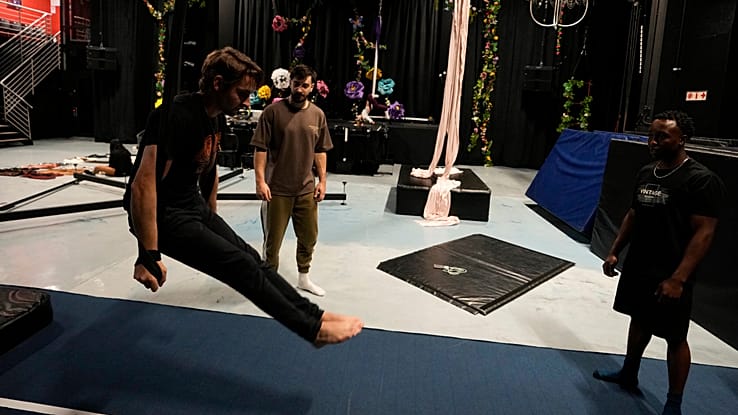
Performers train for years to build the strength, flexibility and discipline needed to work professionally. Some become instructors, while others take paid work with production companies or The Cirk, a professional Johannesburg circus company.
The program is designed to sustain itself through training, performances and other circus work rather than relying entirely on outside funding.
Ngobese’s older brother first introduced him to South African street and social dancing. He later moved into contemporary, hip-hop and other styles, building on a love of performing that began in childhood.
He found circus almost by accident after auditioning as a dancer for a Joburg Theatre production in 2019. What began as a short job became a career when The Cirk invited him to stay and train.
Ngobese received support for training and transportation through Jozi Circus School’s youth development program. The school partners with The Cirk, where he now works.
“Cirk was like an adventure,” he recalled. “When I saw people flying, I was like, ‘Is this what they’re doing here?’ Okay, this is life. I’m like, ‘Let’s go for it.’”
Years later, Ngobese would quickly mend a tear in his costume, his eyes streaked with red and yellow makeup, as he prepared to go on stage.
The animal-free circus show blends choreography with gravity-defying acrobatics on silks and hoops. Ngobese plays a “little star” journeying through oceans, fantastical lands, and fiery fortresses in search of what will make him shine.
The role reflects Ngobese’s own journey into a world he had never imagined for himself.
Circus also brought Ngobese together with Zenzele Letsoela, a fellow dancer from Alexandra.
“I’m grateful to Cirk for bringing me another brother I didn’t know I actually needed in my life,” said Ngobese.
Together, they combined dance with circus skills and began attracting attention beyond the school. “People were like, ’Where are those guys? We want those guys. We want to see more,” he said.
Letsoela, 38, trained in ballet and pantsula, a fast-paced South African township dance style. Moving into aerial acrobatics brought an unexpected challenge: he is terrified of heights.
“I wouldn’t say I’ve learned to overcome my fear of heights, but I’ve learned to work around it,” he said.
Hoisted about two meters above the stage as a magical tree, Letsoela stays in character despite the nerves.
“People don’t see that I’m actually nervous going into the air. I look very comfortable,” he said. “And I’m like, if only you guys knew, I am dying inside.”
By the end of the show, Ngobese, glittering in gold as the little star who has finally found where he belongs, was back in the air hanging from an aerial silk by one arm as gasps gave way to more cheers.