
By : Sweden Desk | Confirmed by Sweden office
Kampala / Mpigi / Kigali — On October 17, 2026, residents of Luwala village, in Kamengo, Mpigi District, Uganda, found a headless body inctation.
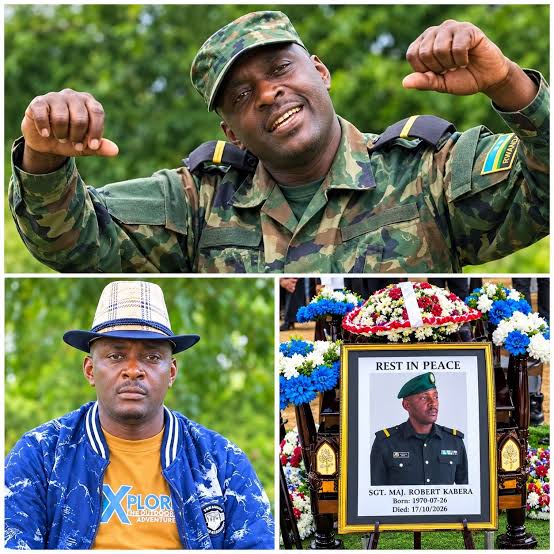
Police later confirmed the body was that of Sgt Maj Robert Kabera, known as Sergeant Robert or Major Robert, aged 50. He was a musician, a former soldier in the Rwanda Defence Force, who had fled to Uganda, where he had become a fierce critic of the Rwandan government on YouTube.
His head has never been found. His killers are unknown. The motive for his murder is unknown.
This is his full story — from music, to exile, to his tragic death.
1. WHO WAS KABERA ROBERT?
Robert Kabera was born in Rwanda. He joined the army in 1993, and immediately joined the military music group, Army Jazz Band.
In 2008 and 2009, The New Times newspaper featured him as the bandleader of the Army Jazz Band and a solo singer. His song “Weekend” made him famous across Rwanda. He was known as a musician who performed at Liberation Day celebrations, in churches, and elsewhere.
He was also a military instructor. People knew him as a funny, singing, friendly man.
After many years in the army, his life changed completely in 2020.
2. WHY DID HE FLEE TO UGANDA?
Kabera said he fled Rwanda on November 19, 2020, saying he feared arrest and feared for his life.
He said the reason was political persecution and fear for his safety. He said his problems were linked to his family, because he was the nephew of Fred Rwigema, the first commander of the RPF.
On the other hand, the Rwanda Military Prosecution Authority, on November 23, 2020, announced it had opened an investigation into Kabera on allegations of unlawful sexual contact with a child in his family in Ndera, Gasabo District.
Kabera denied the allegations, saying they were politically motivated fabrications. His brother, Victor Agaba, also denied them:
> “Our problem comes from home… The army created a criminal case against him. It was a witch-hunt.” — Victor Agaba
IMPORTANT NOTE: These allegations were never proven in court. Kabera was never convicted of any crime. HRW also says it could not confirm the truth of these allegations. No one should treat these allegations as proven fact.
Kabera fled with his wife, Jeanne d’Arc Rwigema Uwizeye, and his children, to Uganda to seek asylum.
In May 2023, the Inspector General of Police of Uganda wrote to HRW confirming that Kabera had been granted asylum in Uganda on political persecution grounds, that he was given extra police protection, and that he was in the final stage of resettlement to a third country.
But, even though he was in the final stage, he waited 6 years without being resettled.
3. HIS LIFE IN UGANDA: YOUTUBE CHANGED HIS LIFE
In Uganda, Kabera became very famous on YouTube.
He created a channel called Major Robert TV, which had more than 144,000 subscribers and more than 800 videos.
In those videos, he fiercely criticised President Paul Kagame and the Rwandan government, speaking about crimes he accused the ruling party of, and about the persecution he faced in exile.
One of his songs praised Victoire Ingabire, a Rwandan opposition figure who has been imprisoned many times.
This made him a powerful voice among opposition figures living abroad. But it also made him a target.
4. HE KNEW HE WOULD BE KILLED — HE TOLD HRW
Kabera told HRW many times that he was assaulted and threatened in Uganda.
– On May 16, 2022, many Ugandan police officers raided his house, arrested him, took him to the Special Investigations Division in Kireka, accusing him of illegal possession of a firearm. He was later released on police bond.
– On September 11, 2021, he wrote to local authorities asking for protection, saying he feared for his life.
– On October 23, 2023, the chairman of Sserwanga village in Kampala wrote to Old Kampala Police saying Kabera was attacked by 3 men on Rubaga Road. They reportedly told him:
> “Even if you flee to America, we will follow you and kill you.”
In September 2022, he told HRW in painful words:
> “They will kill me. They know where I am… I will die before I get resettled.”
HRW recorded his security concerns in its October 2023 report titled “Join Us or Die”, about repression against Rwandans abroad.
5. HIS LAST NIGHT: OCTOBER 16, 2026
Kabera’s last day remains a great mystery.
According to his family:
– On October 16, at 7:00 p.m., Kabera left Kampala for Luwala, Mpigi, where he was building a house, accompanied by his regular boda boda rider named Innocent.
– He arrived, went to a bar at Luwala market.
– At 11:30 p.m., he returned home to pick up his phone, then left again.
– He appeared to be with an unidentified Kinyarwanda-speaking man who claimed to be an opposition figure needing assistance.
– He called his family at 11:00 p.m., then never picked up his phone again.
On the morning of October 17, his brother Victor Agaba found the house locked, and went to search for him. At 2:00 p.m., the village security secretary told people that a headless body had been found.
Kabera was lying in a pool of blood in a eucalyptus plantation, near where he was building his house. His head was gone. His hands were tied behind his back.
Police found:
– A large stick reportedly used to beat him
– Two bottles of beer — one empty, one half-full
– His shoes
Police said the murder may have happened in the night of October 16 to the morning of October 17.
6. WHAT HRW SAYS
On October 22, 2026, HRW called on Ugandan Police to conduct a prompt, impartial, and credible investigation, examining all evidence that could point to a politically motivated murder.
HRW analysed a photo and 3 videos of his body. A forensic medical expert told HRW that:
– The body was likely decapitated after death
– Bruises on the shoulders and ligature marks on the wrists suggested his hands were tied behind his back when he was killed
HRW said:
> “It was clear from our conversations that Robert Kabera knew his criticism of the Rwandan government made him a target, and that he feared for his life.” — Clémentine de Montjoye, Senior Great Lakes Researcher at Human Rights Watch
HRW also called for other Rwandans living abroad to be protected.
Days before his death, Kabera posted on YouTube a video titled “Kill Us if You Want”, where he spoke about crimes he accused the ruling party of and the intense persecution he faced in exile.
7. CONFLICTING CLAIMS — WHO KILLED HIM?
To date, no one has been identified as Kabera’s killer, and no one has been arrested.
But two different claims have been made:
1. Claim by Gen. Muhoozi Kainerugaba:
On October 27, 2026, the Chief of Defence Forces of Uganda, Gen. Muhoozi Kainerugaba, wrote on X:
> “I suspect some elements of Kayumba’s RNC did it. Are they avenging the arrest of Kandiho? We shall know the truth.”
He suggested it could be revenge for the arrest of Maj Gen Abel Kandiho, who was arrested on September 9, 2026. He provided no evidence.
2. Claim by a police officer to his wife:
His wife, Jeanne d’Arc, said when she went to collect Kabera’s body, a police officer told her:
> “In Uganda, people kill each other. They hit from behind, strangle a person to death. But this murder is different. This murder is professional. Robert Kabera’s death is Made in Rwanda.”
His wife says the officer meant the murder was well-planned, not an ordinary murder in Uganda.
Uganda Police has neither confirmed nor denied these claims. Police spokesperson Kituuma Rusoke only confirmed that the head has not been found, the investigation continues, and no suspect has been publicly named.
NOTE: Neither side has presented confirmed evidence. Justice must be based on evidence, not on speculation.
8. HIS FAMILY IS CRYING
His wife, Jeanne d’Arc Rwigema Uwizeye, told BBC Great Lakes in a written message:
> “It is painful. I feel I have lost my mind, the children and I have no security.”
His brother, Victor Agaba, told AFP that Kabera had no personal conflict with anyone in Uganda, that his problems came from home.
The political group Rwanda National Congress (RNC) called for a full, independent investigation, and for those responsible to be brought to justice.
9. WHY IS HIS DEATH SO SERIOUS?
Kabera’s death was not an ordinary death. It matched other events that happened before:
– HRW said many Rwandans who oppose the government living abroad have been killed, abducted, or forced to return to Rwanda.
– Kabera had been told he would be killed.
– He had been granted asylum, but was not resettled for 6 years.
– He was killed in a brutal way — decapitated, his head taken away.
Many people are asking:
Why did UNHCR not resettle him earlier? Why did Uganda Police not protect him? Who killed him?
CONCLUSION
Robert Kabera was a musician. He was a soldier. He was the bandleader of the Army Jazz Band. He was a father. He was a critic of the government on YouTube.
He fled his country saying he feared for his life. He told the world he would be killed. He was killed — decapitated, his head taken to an unknown place.
Now, his wife and children have no security. His brother is demanding justice. HRW is demanding an independent investigation. Uganda Police says the investigation continues.
One question remains: Will there be justice? Or will Kabera become another person who died for speaking the truth, his head lost forever?
Rest in Peace, Sergeant Robert Kabera.
Confirmed by Sweden Desk | Sweden office