
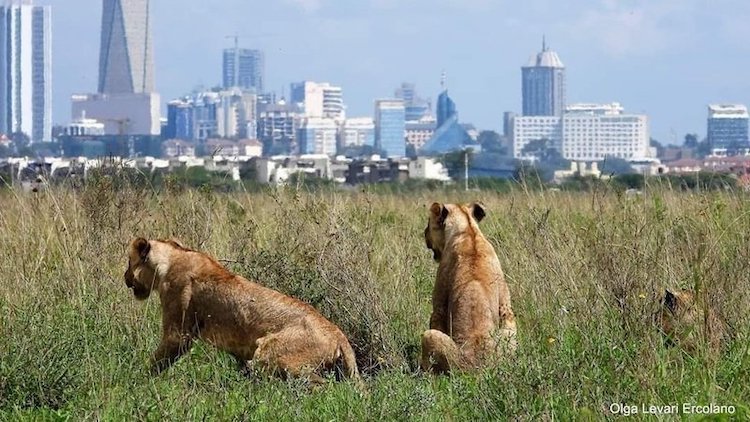
A pride of lions lounges in the savannah of the Maasai Mara in Narok, Kenya, Sunday, April 5, 2026.
Africa’s lions are running out of space. Habitat loss, shrinking prey populations and growing conflict with communities are putting the continent’s big cats under mounting pressure, with retaliatory killings and poisoning posing an added threat to their survival.
Brushing through the grass at Kenya’s Ol Pejeta Conservancy and tearing into flesh as they feed, these lions represent both the country’s wildlife wealth and one of its toughest conservation challenges.
Lions are a major attraction for tourists and photographers and play a crucial role as apex predators in maintaining healthy ecosystems.
But across Africa, their numbers have fallen sharply. The Africa Wildlife Foundation estimates the continent’s lion population at between 20,000 and 23,000, down by about 43% over two decades.
In Kenya, an estimated 2,500 to 2,600 lions remain.
Philip Muruthi, vice president for species conservation and science at the Africa Wildlife Foundation, says habitat loss and fragmentation are the biggest threats facing Kenya’s lions.
“Kenya’s lion populations which number about 2,500 to 2,600 face the major threat facing their conservation and their future well being is habitat loss and fragmentation,” he says.
The loss of habitat also means less prey, while expanding human settlements increasingly bring people and predators into contact.
When livestock becomes prey
The pressure is particularly intense around the edges of protected areas, where livestock grazing can alter lion behaviour.
Research in Kenya’s Maasai Mara has found that lions avoid areas used by livestock, even after the animals have left. That effectively reduces the space available to the predators and can push them closer to human settlements.
When lions kill livestock, the consequences can be deadly.
Communities facing repeated losses may retaliate by killing the predators responsible.
Muruthi says retaliation has become one of the key threats to lions in Kenya.
“When conflicts occur, the lions might come in contact with the livestock, eat them and people retaliate and one of the key threats here in Kenya to lions is really retaliation, people killing lions because they ate their livestock,” he says.
Poisoning turns conflict into crisis
Earlier this year, six lions and dozens of vultures were poisoned in Kenya’s Amboseli area, highlighting how a single livestock conflict can trigger a much wider conservation disaster.
Conservationists say poisoning often occurs when communities feel they are bearing the costs of living alongside wildlife without seeing enough benefits.
David Mascall, a lion conservationist, says poisoned carcasses can be used to target predators after they kill livestock.
“The problem is with increasing populations of people and increasing livestock in those areas, has led drastically to lions and other predators starting to prey on livestock,” he says.
Mascall identifies Furadan, a pesticide, as one poison that has been used in such incidents.
The consequences can extend far beyond the intended target. Lions feeding on a poisoned carcass can die, followed by hyenas, vultures and other scavengers that consume the remains.
“If 10 lions fed on that carcass that had been spliced with this poison, all of them would die,” Mascall says. “The hyenas that came also to feed on them and the remains of the carcass would die. The vultures, most of them would die.”
Making wildlife worth protecting
Conservationists say protecting lions requires more than securing national parks and wildlife reserves.
It also means ensuring that communities living alongside predators have practical reasons to protect them.
Kenya’s conservancies are increasingly being used to link wildlife protection with local livelihoods through employment, conservation enterprises and other economic opportunities. 
Muruthi says the challenge is to make wildlife an asset rather than a burden for communities.
“How can we turn wildlife into an asset?” he asks, pointing to conservation enterprises, jobs and measures that reduce the cost of living alongside wildlife.
“When people can start to see that this is an asset, this is not always a loss to me,” he says.
Education is another crucial part of the effort, Mascall says, particularly for households keeping livestock close to predator habitat.
“The survival of our wildlife generally, our lions in particular relates to education more than anything else,” he says.
A future shared with people
As Africa marks International Lion Day on August 10, conservationists warn that the future of the continent’s lions will depend increasingly on what happens beyond the boundaries of protected areas.
Habitat protection, better livestock management, compensation and community-led conservation can help reduce the pressure.
But without addressing the costs borne by people living alongside wildlife, conservationists fear that conflict will continue to put lions and other predators at risk.
For Africa’s lions, survival is no longer only about protecting the animals. It is also about making coexistence work for the people who share their landscape.

© 𝐍𝐞𝐰𝐬 𝐏𝐚𝐩𝐞𝐫𝐬 / 𝐑𝐚𝐝𝐢𝐨 / 𝐓𝐕