
USA
For nearly two minutes, one of the pilots of the Amazon cargo plane that careened off a Miami runway and killed five people repeatedly warned his counterpart they were going too fast as they approached for landing and after touchdown, according to flight information released Wednesday.
A summary of cockpit voice recordings compiled by the National Transportation Safety Board said the fellow pilot never gave “a consistent verbal response” to the warnings.
The plane touched down awkwardly, briefly attempted to take off and then smashed into a van carrying the five victims.

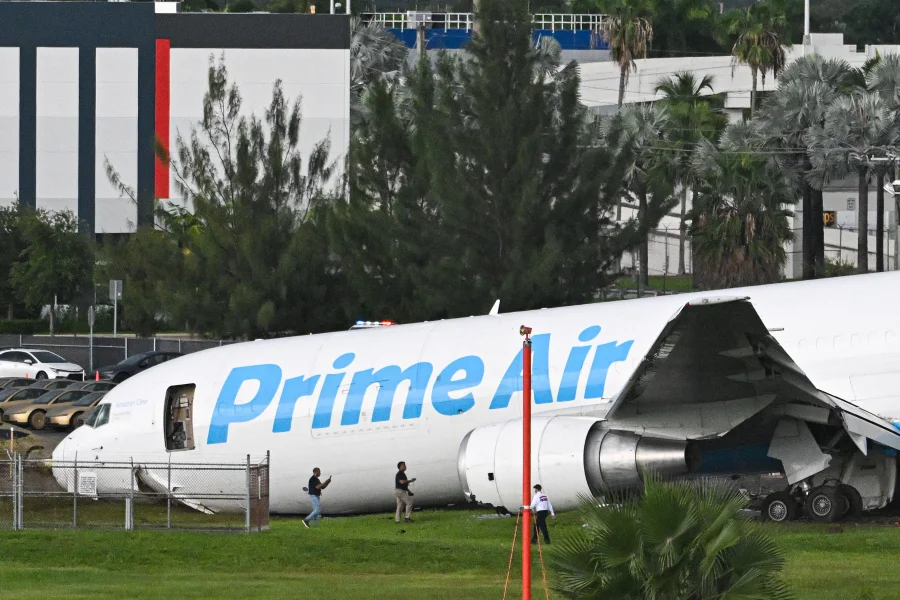
The Amazon plane came in fast on Sunday afternoon and then barreled roughly 396 metres past the end of the runway and smashed into a van carrying workers at a plane cleaning company before hitting a compact SUV as it slid across a public road before catching fire.
All five people who died were in the van. Five others were hurt, including two who remained in critical condition on Tuesday. The two pilots survived and were interviewed Wednesday by investigators.
At the point when the pilot first called out the plane was speeding, former FAA official Mike O’Donnell said the crew could have done a number of things to slow it down, including extending the spoilers, cutting the throttles and lowering the landing gear. Or the pilots could have just aborted the landing at that point and circled to try again.
“You have plenty of time to slow down, plenty of time to say, let’s just do a go-around at two minutes out,” said O’Donnell, who used to oversee airport safety and crash investigations.
Information from the flight data recorder that was released late Tuesday shows how unsteady the plane was as it came in to land amid strong winds, and then the pilots briefly disengaged the brakes and shoved the throttles up as if they were trying to take off again and retry the landing. But they abandoned that just four seconds later.
The cockpit audio recordings also captured a series of automated warnings from the plane about the speed of descent and the approaching terrain.
O’Donnell said those terrain warnings reinforce that the plane was unsteady and suggest it may not have been configured correctly for landing.
The Amazon plane was well down the runway when its right and nose landing gear first touched down, reducing how much distance the plane had on the runway ahead of it to stop.
Strong winds at the airport as storms moved in may have created a tail wind that helped propel the plane forward.
Tracking site Flightradar24 estimated based on the NTSB data that the plane was nearly halfway down the 9,360-foot runway when it first touched down.
The full transcript of the cockpit conversation won’t be released until later in the investigation.